
Most of us learned revenue models in two flavors. Consumer companies (B2C) sold to individual people. B2B companies sold to other companies through sales teams, distributors, dealer networks, and partners. For a long time these were separate worlds.
B2B buyers now expect to buy just as they do at home, resulting in traditionally B2B businesses building direct-to-customer channels, and the marketing to support them. The driving force behind this is the Customer. In my retail roles I became fond of the mantra: everything, all the time (yes, that's stolen from The Eagles), meaning an infinite product catalog, instantly available, everywhere, at all times. B2B Customers are starting to expect the same.
B2B Customers Want Direct Sales Channels
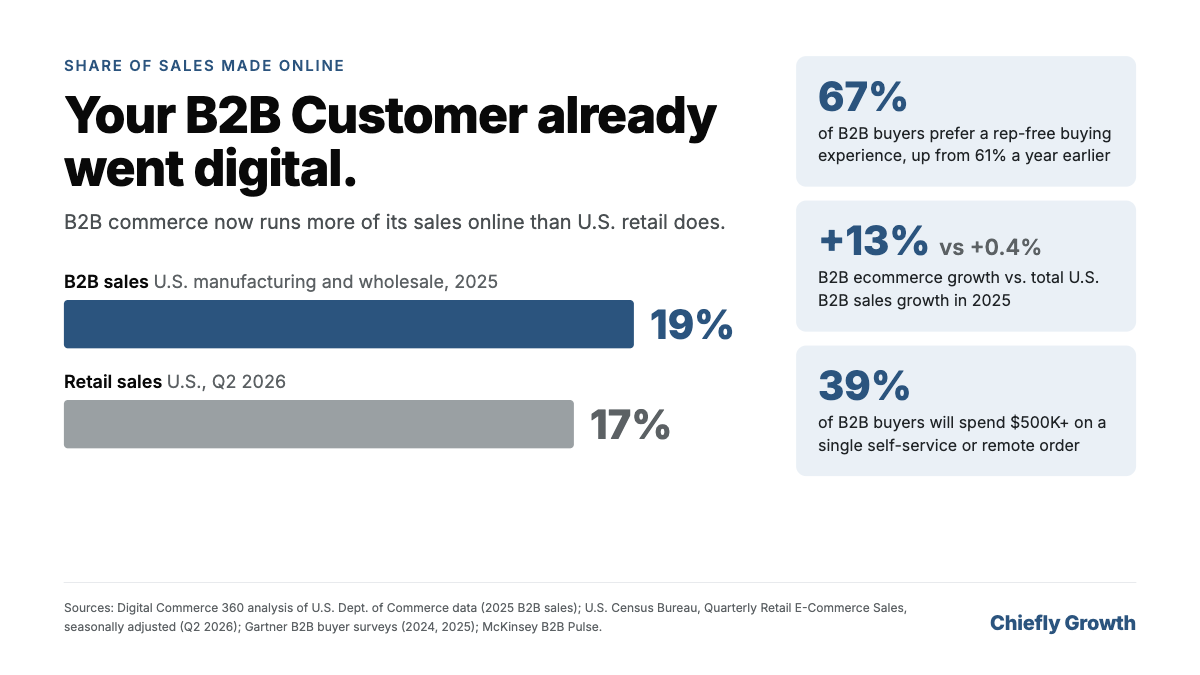
Two out of three B2B buyers would prefer to skip a sales representative. In a Gartner survey, 67% said they prefer a rep-free experience, up from 61% the year prior. This isn't limited to small, repeat orders. McKinsey's B2B Pulse found that 39% of B2B buyers are willing to spend more than $500,000 on a single order through self-service or remote channels.
Industry data supports these insights. In 2025, total U.S. manufacturing and wholesale sales grew just 0.4%, while B2B ecommerce grew 13%. The same data shows that 19% of B2B sales now happen online (read that again, it’s that big). For comparison, U.S. retail ecommerce was 17% of total retail in Q2 2026. B2B commerce may be more digital than consumer retail!
Why Go Direct?
The motivation goes beyond simply Revenue and following Customer preferences. This "last mile" to the Customer gives a B2B company control over its brand and customer experience, a direct view into Customer insight, as well as flexibility in pricing, fulfillment, and the relationship itself. For years, many B2B companies knew their distributors better than the people who actually used their products. A direct channel changes that.
Going direct isn't simple, though. A 2025 Sybit and Techconsult study found 94% of companies see a need for outside help setting up direct structures. Organizations that understand, connect with, and ultimately serve the Customer can and will win.
How to Go Direct, Customer First
A direct channel built around the Customer looks very different from one built around a product catalog. Before choosing platforms or pricing, answer these four questions.
Who Is Your Customer?
Taking time to truly understand your Customer always pays off. In my experience, surveys and interviews provide context, nuance, and depth. Your internal data helps you understand the scale and how the Customer connects to your finances.
How Does Your Customer Buy?
Map where they research, compare, and transact, and which moments still need a person. Taking time to understand the full breadth of your sales funnel and sales channels is essential. It's the kind of thing teams assume they know, until they map it and find important gaps.
Where Are The Opportunities?
There are often myriad options to extend into new sales channels, but they're not all good. Documenting the options, the investments required for each, and expected timing and milestones are essential. Weigh each option against what your Customer actually values.
What Is The Size Of The Prize?
Not all revenue through a new channel is incremental, and it may not be realized at the same margin. Additionally, a new sales channel may be stickier (or less sticky) for your Customer, and that can affect customer value (LTV). Beyond the monetary, a direct-to-customer offering can act as an information sponge. Building the framework and systems to capture the right information, and keep your data private where needed, is more important than ever.
The Bottom Line
Direct-to-customer channels continue to be a huge opportunity for many organizations, delivering not only new revenue but valuable insight and data. The Customer is the constant. If your business is weighing a direct channel, or rebalancing the one you have, that's a conversation worth having early.
Sources